Mudjacking has been used since the 1930s and remains the most cost-effective way to lift large, heavy slabs. As the slurry fills the voids under a settled slab, the slab floats back up to level. Nothing is demolished and nothing is re-poured.
Free mudjacking quotes in Peoria: (309) XXX-XXXX
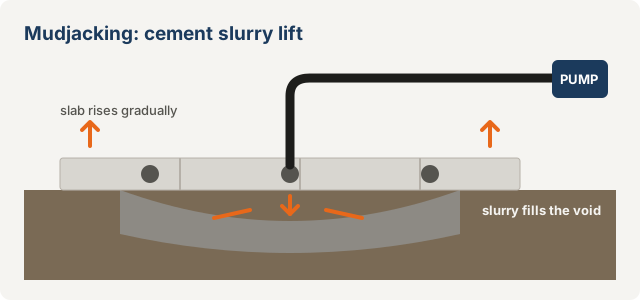
How mudjacking works
- Drill. A pattern of holes, each about the size of a soda can, is drilled through the settled slab.
- Pump. A slurry of sand, cement and soil is pumped under pressure, filling the voids beneath the slab.
- Lift. Hydraulic pressure raises the slab gradually back to grade, checked with levels as it moves.
- Patch. The holes are filled with fresh concrete and troweled smooth.
A typical residential job takes 2 to 4 hours. The slurry needs about 24 hours to cure before carrying heavy loads, so a driveway mudjacked in the morning is ready for the car the next day.
What mudjacking is best for
- Large, heavy slabs: full driveways, garage floors, warehouse slabs
- Big voids, where washout has hollowed out significant space
- Budget-driven jobs: mudjacking is usually the lowest-cost lifting method per square foot
For smaller slabs, tight access, or same-day use with a waterproof fill, consider polyjacking with polyurethane foam. We quote both options where each makes sense.
How much does mudjacking cost in Peoria?
Most residential mudjacking in the Peoria area runs $500–$1,500 (about $3–$8 per square foot), with larger driveways toward $2,500. The price depends on slab size, how far it has dropped, and how much void needs filling. Replacing the same concrete typically costs two to three times more, before counting damaged landscaping and a week of curing time. Project-by-project ranges: Peoria cost guide.
Ranges are typical for this area, not quotes. Estimates are free.
Why concrete settles in Central Illinois
Central Illinois clay swells and shrinks with moisture. Downspouts discharging beside a slab wash out the base layer. Builder backfill that was never properly compacted keeps consolidating for decades, and the freeze-thaw cycle levers slabs apart every winter. Mudjacking refills what the soil gave up, and sealing the joints afterward keeps water from starting the process again.